
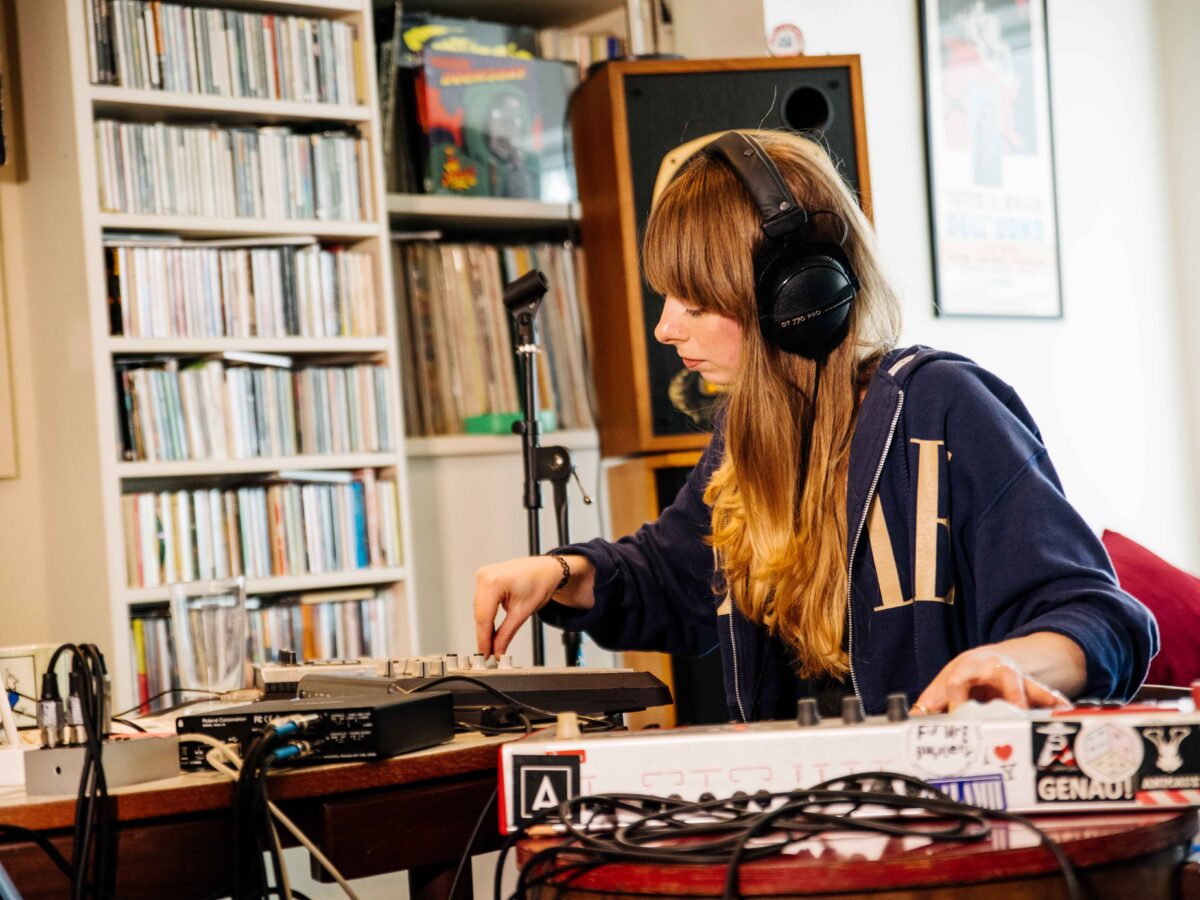
As is our preference here at HighClouds, Elsa Hewitt is an artist that refuses to conform, having made her name since 2017 as one of the most forward-thinking voices in British ambient and electronica.
Her songs are immersive soundscapes, taking after the slowly evolving, ambient textures of artists like Julianna Barwick or Grouper, but still uniquely her own: quirky, colourful, contemplative and uplifting, often evocative of a hot and peaceful summer night characterised by the buzz of crickets.
Her most recent record, Dominant Heartstrings exemplifies her artistic confidence 10 studio records in, with sound design rich in compelling, lo-fi qualities and Elsa’s vocals stronger and more captivating than ever.
Below we present an interview with Elsa, conducted in summer 2024 while she was performing a series of shows across the UK, and also working on Dominant Heartstrings.
HighClouds: How are the live shows going?
Live shows are going well, people have responded very positively. Everyone who has heard the new songs seems to be in agreement that they’re bangers.
I’m enjoying being away from the computer and having a simple set-up that I can tweak, switch and add on to quite easily. I’m also enjoying recording new sounds to add into the set, along with the journey, although it’s something that I was already doing with my improvised ambient sets that I was touring in October 2021.
I’ve noticed my singing has come through when I perform the songs, sometimes unsurprisingly. I’ve been learning a lot of singing technique in the last month after spending my whole life refusing to have lessons due to a fear of sounding like everyone else.
I have realised that it’s more important to protect my voice, and get more freedom, elasticity and power in it, so I’ve started learning from teachers on YouTube. Things have massively shifted forward since making certain discoveries. Plus, some of the songs I’m performing are quite hard to sing due to them being quite a high register for me, with lots of words.
How difficult is to recreate your fairly experimental records in a live setting? Are there recurring challenges, or at this point in your career is the process really natural?
I have tried many different ways of doing solo electronic live sets over the past 7 years. I know now where my limits are in terms of how much I can be doing at one time without getting flustered and not being able to fully feel the flow of the music.
Now I have pretty well established the approach I enjoy, that strikes the right balance. I do enjoy applying it in slightly different ways to all the new songs. Each song provides different opportunities as well as limitations.
One of the main challenges for me is to stand up and being seen without getting shy, without necessarily having to busy myself behind lots of activity to distract myself from the attention.
I’ve been very aware for a long time about this perceived pressure that I need to look like I’m doing loads of stuff, when the reality is there is only so much that I can do alone without completely stripping it back and playing something different to the recordings.
I find a blend is always best. I would love to have a band to figure out completely live versions of my songs.

Elsa Hewitt by Darius Williams
You started recording your 2024 record Chaos Emeralds in lockdown. How did that affect it?
Lockdown imbued it with a certain atmosphere, there was like a mixture of tension and stillness, unusual and new emotions, much sadness and uncertainty, collective feelings, chaos and confusion, all of that was feeding into it.
The music I was making was like the transmutation of these energies, abstract expressions, the sprouts of personal and collective transformation. There was also this renewed sense of love for nature and an appreciation of everything in the immediate environment.
You’ve spoken about how music gave you satisfaction and security when you were young. What do you think the link is between music and mental health?
Music is so evocative, in a spiritual way. It’s a pattern of resonance. When you like certain music it’s because it resonates with you on an energetic level, so in many ways it reminds you that you’re not alone and reflects the beauty of your life back to you.
Equally, it’s the gel that brings people together. I think it can help you tap into your underlying emotions and feelings, and can help you gain a higher perspective because of that. It helps you release what is stuck and move with what is coming through. So, it’s very important.
You used to live and study in Toulouse, France. How did living there affect your growth as a musician?
I did a lot of jamming with musicians I met there. Before going there, I had just made my first electronic album (Hotel Rosemary), so I brought my synth along with me and performed songs from it while I was there.
However, because of the solitude of being in a new place I ended up writing a whole album of songs acoustically, developing my finger picking, writing more in French, listening to a lot of dance music and jamming with a lot with other people. I ended up with a lot of ideas.
Which music comforts you the most nowadays?
I’ve found comforting vibes recently when listening to Terry Riley, Kirk Barley, Lonnie Holley, Ulla; artists I listened to a lot when I was younger, like PJ Harvey and The Beach Boys.
Also, folk music that other people put on, vintage classics and instrumental hip hop beats, especially those made by my friends.
Dominant Heartstrings is out now on Elsa’s own imprint ERH Records.

- A mid-tour chat with ambient electronica virtuoso Elsa Hewitt - March 20, 2025
- Maria Usbeck announces third album with whimsical new track “Mantarraya” - February 26, 2025
- Montreal’s Christian Sean shares surreal and menacing new tune “All in Your Hands” - January 31, 2025


